
The main types of pliers are combination, long-nose, water-pump, slip-joint, locking and cutting pliers, with specialist shapes for jobs such as circlips and wire forming. Choose by the shape of the jaws and the task: broad jaws grip, a narrow nose reaches, and cutting edges cut. One pair rarely does every job well.
This guide explains the differences you are likely to encounter in a home workshop or work van, then shows how to give them a sensible place in a drawer. Layered Works supplies the storage accessories featured here; the pliers and other demonstration tools are not included.
| Type | How to recognise it | Typical purpose |
|---|---|---|
| Combination | Short jaws with flat and curved gripping areas, plus a cutter near the joint | General gripping and bending; cutting within its stated capacity |
| Long-nose | Long, tapered jaws; straight or bent | Reaching and positioning small parts |
| Water-pump | Offset serrated jaws and several adjustment positions | Gripping round or irregular workpieces |
| Slip-joint | Adjustable pivot with a small number of positions | General gripping across different thicknesses |
| Locking | Adjustment screw and release mechanism | Holding a workpiece clamped |
| Diagonal cutters | Two cutting edges, without a long gripping nose | Cutting suitable wire or similar material |
| End cutters / nippers | Cutting edges across the end of the head | Cutting where access is needed from the end |
| Circlip | Small tips for retaining-ring holes | Fitting or removing the specified type of circlip |
| Flat-nose / round-nose | Broad flat jaws or two rounded tapered jaws | Holding or forming material; making wire loops |
Names sometimes overlap between manufacturers. Use the exact model specification to confirm its function, jaw capacity and cutting limits. KNIPEX’s overview of plier families is a useful visual reference.
Start at the working end rather than the handle colour. Look for flat gripping faces, serrated curved jaws, cutting edges or fine tips. Then inspect the joint: is it fixed, adjustable or fitted with a locking mechanism? Two tools with similar handles can do quite different jobs.
Combination pliers bring gripping and cutting features together. Long-nose pliers have a tapered reach for smaller parts and confined spaces. Some long-nose models include cutters; others focus on gripping. Bent-nose versions change the approach angle. Match the tool to the access needed, rather than expecting a fine tip to do heavy gripping.
Both offer adjustable jaw openings. Water-pump pliers usually have angled jaws and a wider range of adjustment positions; simple slip-joint pliers commonly have fewer. Serrated jaws suit gripping tasks but can leave marks. Check the manufacturer’s instructions for the workpiece and adjustment method.
A pliers wrench is a separate option with parallel gripping jaws. It should not be confused with serrated water-pump pliers. Compare the actual jaw design in the KNIPEX pliers wrench range before choosing between them.
Locking pliers hold a clamping position using an adjustment and release mechanism. They come with different jaw profiles, so “locking” describes how they operate rather than one particular head shape. The manufacturer’s grip-plier range includes straight, round and long-nose versions. Allow room for the adjustment screw and release lever when storing them.
Diagonal cutters, often called side cutters, have cutting edges at the head. End cutters have edges across the end, giving a different approach to the work. Neither name guarantees a particular cutting capacity or a completely flush finish. Use the stated material and diameter limits for your exact model.
Keep precision cutters separate from heavier cutting tools. KNIPEX lists distinct diagonal cutters for applications including plastics and high-leverage cutting, which is a good reminder that similar-looking heads are not automatically interchangeable.
Circlip pliers use small tips to engage the holes in a retaining ring. Internal and external versions serve different ring positions; tip size and access angle also matter. Check the ring and model specification, using the manufacturer’s internal and external snap-ring categories as a reference.
Flat-nose pliers hold or form material with broad faces. Round-nose pliers form curves and loops in suitable wire. Parallel-action designs keep their jaws parallel as they move. Maun’s guide to plier shapes and uses explains these distinctions. Store fine jaws where larger tools cannot knock against them.
For an ordinary nut or bolt, start with a correctly fitting spanner or socket. Do not treat gripping pliers as a torque tool. Likewise, an ordinary gripping jaw is not a substitute for a specified crimping die or wire-stripping tool. This is a tool-identification guide, not instructions for working on live electrical equipment.
The most useful drawer layout makes the right tool easy to recognise before you pick it up. Put everyday combination pliers, long-nose pliers and cutters together, then give larger grips and delicate specialist tools their own spaces.
For a wider workshop plan, see our garage tool storage ideas for walls and drawers. If the drawer travels in a vehicle, read the restraint considerations in our work van storage guide as well.
Our plier organiser range provides storage for tools you already own. Compatibility depends on the actual handle shape, thickness and available clearance; a familiar brand name alone does not establish fit.
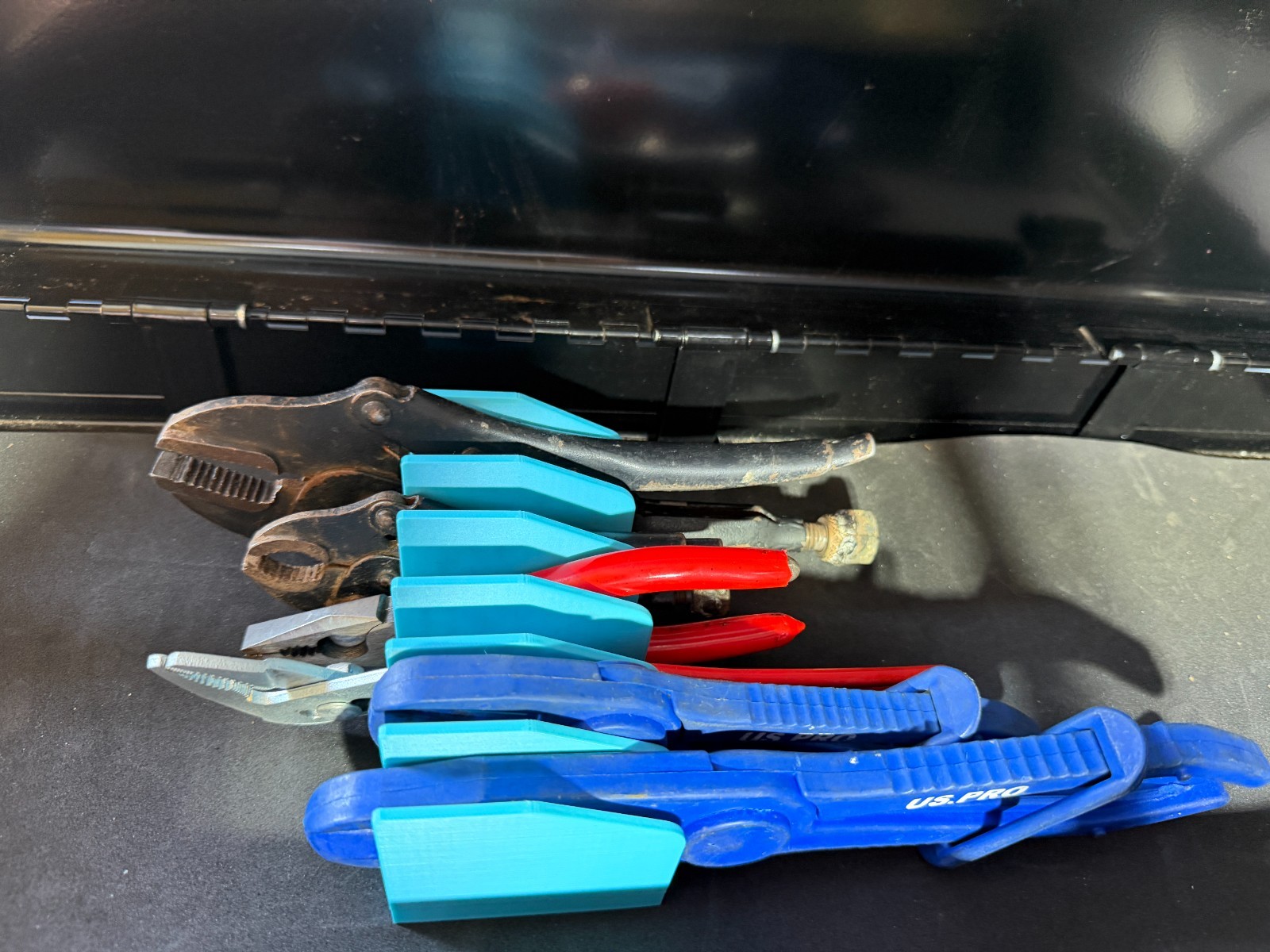
The Plier and Other Tools Organiser | Fits a range of brands holds up to six tools, with four standard slots and two slightly larger slots. It includes two 12 × 3 mm magnets fitted into the base. The mixed layout is worth considering when your collection includes both slim cutters and bulkier grips. Check fit before ordering; it is not a universal holder for every pair.
The Plier & Other Tools Organiser | Fits a range of brands | Drawer Organiser uses linked sections. The listing offers Starter, Workshop and Pro kits for up to six, ten and fourteen tools respectively.
| Kit capacity | Approximate assembled row length |
|---|---|
| 6 tools | 210 mm |
| 10 tools | 350 mm |
| 14 tools | 490 mm |
Each section is approximately 35 mm wide × 60 mm deep × 33 mm high. Those are section dimensions, not the internal slot opening or the clearance needed with tools loaded. Selected support blocks contain fitted 12 × 3 mm magnets; the fourteen-tool option also includes four end caps. The product is listed as PLA and supplied as the selected organiser kit, without the photographed equipment.

The modular product is adapted from “Wrench Holder Organizer” by PANDAONTOP on MakerWorld, under Creative Commons Attribution-ShareAlike 4.0 International. Layered Works adapted it for magnetic drawer storage and prints and sells it independently; the original designer does not endorse the product. Attribution and licence details are retained on the linked listing.
Use these magnetic organisers on a clean, flat, suitable steel surface. Magnetic support helps position the organiser in a drawer; it does not establish suitability for vertical mounting or secure equipment while a vehicle is moving. Check stability with your tools and use appropriate transport restraints where needed.
There is no single useful total: manufacturers divide pliers into families, specialist applications and many size variants. For a workshop collection, begin with the gripping, reaching, locking and cutting functions you actually need, then add specialist tools for specific tasks.
The names often overlap in tool listings. Check the actual nose length, taper, straight or bent shape and whether a cutter is included. Two pairs sold under similar names can offer different access and capacity.
Gripping pliers hold or form material; cutters are designed around cutting edges. Combination pliers can include both features. A visible cutter still needs to be checked against the manufacturer’s material and size limits.
Long-nose or bent-nose models can provide access where broad jaws will not fit. Check the space needed to open the jaws and move the handles, rather than judging access from the closed tool alone.
Measure the widest part that must pass into the slot and compare it with the holder’s usable opening. Overall section width is not slot width. If a listing does not give the needed measurement, send Layered Works your tool model and measurements before ordering.
Give bulky locking grips, large adjustable pliers and delicate tips enough space to avoid interference. Do not force thick handles into a slim slot. A flat compartment or a different holder may suit an awkward tool better than the main plier row.
You can request a custom print through our contact page. Include tool measurements, photographs and available drawer space. Requests are subject to feasibility review, so confirm the proposed fit and design before ordering.
Choose the plier type for the job, then choose storage around the tools you actually own. Browse Layered Works plier organisers or ask us about an uncertain fit before ordering.